
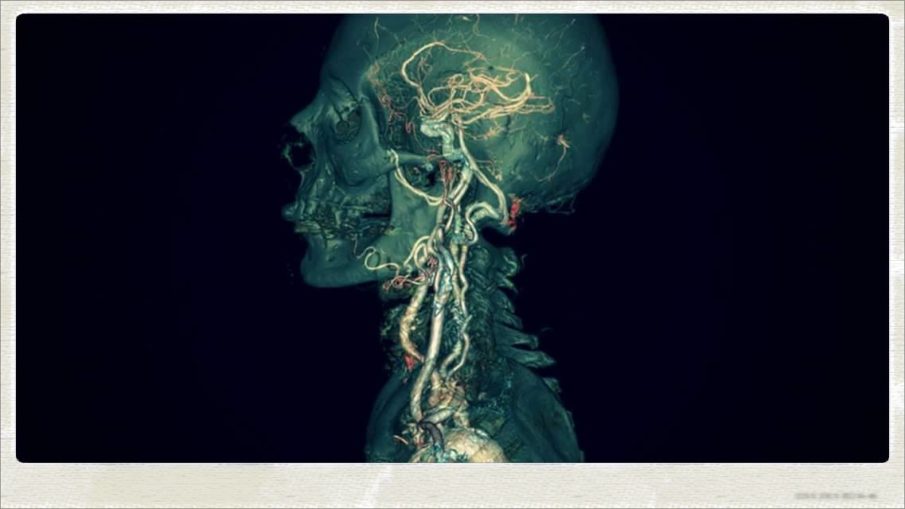
“ A 70kgs (154lbs) male’s circulating blood volume is about 70ml/kg which equals about 5 litres. Cardiac output is about 5-7 litres per minute. All the great vessels of the body act as a conduit of approximately 15-20% of CO/minute which equals about 1 litre per minute. The great vessels include the innominate artery, Subclavian arteries, carotid arteries and some include the iliac arteries. The 4 atria, 2 ventricles and aorta all conduct the full cardiac output thus are well protected in the centre of the body behind the sternum and in front of the thoracolumbar spine.”
So why is the above noted information important? Because hemorrhagic shock (blood loss) is based upon how much hydraulic fluid (blood) is leaked from the body. When it comes to understanding hemorrhagic shock, I would guide you to the following links that were provided to me by Dr Porayko:
http://ccforum.com/content/8/5/373
http://ccforum.com/content/8/5/373/table/T1
Dr Porayko advised that based upon the above noted link:
• A class II shock category (750-1500ml) would leave “most” dizzy and very weak
• a Class III or Class IV shock category (1500ml-2 litres of blood loss) would leave “most” with the inability to stand upright
Specific to my questions about unconsciousness and death if specific anatomical arteries or veins were cut, and given all the medical variable associated, the Doctors had to make the following assumptions first before they could answer my questions:
- There is no compression of a lacerated artery underway. This was irrelevant for a lacerated vein due to the fact that a vein can’t be compressed
- The subject is previously healthy with a normal haemoglobin concentration and has a normal VO2 max prior to being wounded.
- If an artery is the target, the artery is incompletely transacted. Completely transacted arteries go into vasospasm and retract into their perivascular sheaths which markedly reduces bleeding and even stopping bleeding all together in the case of smaller vessels. On this point Dr Porayko stated that this is the reason the Ghurkhas were trained to twist their knives in the femoral artery after puncturing it- to avoid a clean surgical transaction, thus preventing the vasospasm and retraction into the perivascular sheath, and instead to intentionally cause a hole in the vessel sidewall which is much more lethal.
- The adventitia (a saran wrap like layer around the blood vessel) does not seal the wound ( The doctors stated that this usually does happen in survivors) and/or a clot does no form after blood pressure drops.
The doctors also noted:
“although exsanguinations (death from blood loss) from a venous injury is much slower that an arterial one (because mean arterial pressure is usually at least 10x central venous pressure), the venous injury is much more difficult to treat and generally if arterial injured patients survive to hospital with manual compression, they will do well whereas major venous injured patients often die even after getting to the operating room”
Of note, both doctors opinioned that the numbers provided by Fairburn and other combative/martial arts instructors that I provided to them for review, specific to times for unconsciousness and/or death, are way too short. Both stated that they believed that these numbers are based upon “complete cessation” of all cardiac output through the involved vessel which is not the norm. In fact Dr Pryayko brought to my attention that during the French revolution when thousands of people were beheaded by guillotine, the attending doctors documented the presence of vital signs in the body for up to two minutes.
So based upon the above 4 “assumptions”, here are the numbers that the doctors I consulted provided specific to a level of hemorrhagic shock taking place which would lead to unconsciousness or death in “most” situations:
Carotid Artery:
Approx 2-20 minutes
Jugular Vein:
Approx 15-60 minutes
Subclavian Artery:
Approx 2-20 minutes.
The doctors also noted: “this is a special circumstance anatomically because this vessel is protected by the clavicle and the first rib (sandwiched between them) if the Subclavian artery bleeds, the only way to compress it and repair it is to open the chest by thoracotomy. You cannot compress it. Patients usually die on the scene or en-route to hospital.
Subclavian Vein:
Approx 15-60 minutes
Brachial Artery:
5-60 minutes. The doctors also noted: “pretty unusual to see these without compression by EMS)
Femoral Artery:
5-60 minutes. The doctors also noted: “Pretty unusual to see these without compression by EMS)
Aorta or any part of the heart:
Approx 1-2 minutes. The doctors stated that the heart conducts 100% of cardiac output. Assuming transaction and that the hole does not seal. Ventricular holes do usually seal while the atrial ones do not due to the orientation of the muscle fibers.
Two other areas of note made by the doctors also included:
Popliteal Artery:
Located behind the knee, would be similar (but slightly less) to cutting the femoral artery
Inferior Vena Cava:
Can be attacked via a deep abdominal stab, similar to cutting the Jugular vein
Both doctors stated that these are estimates based upon current medical literature and their first hand experience, but both also stated that there are always exceptions to these estimates. Both gave examples where patients who had received severe knife wound survived even with a heavy loss of blood, some examples:
• One of the doctors has seen several patients with traumatic cardiotomies (a big hole in the heart) survive for 20 minutes before being treated
• One of the doctors treated a patient who had been stabbed in the abdomen, where the knife hit the inferior vena cava, his belly was full of blood, he was conscious, although shocky, an hour after the injury when he arrived in the ER. He survived.
The doctors stated that they have seen patients who have bled out nearly their entire blood volume, but yet are still awake and talking (although looking bad) many minutes following an injury and survive to tell their story. Dr Porayko stated, “So it is a mistake to underestimate a person’s capacity to compensate for acute hypovolemia and anaemia (hemorrhagic shock), even when very severe. This is especially true in the younger population.
Conclusion
So why did I write this article?
1. Much of the information being propagated in the martial arts, self-protection, and combatives industry specific to unconsciousness and death as a result of an edged weapons attack, specific to blood loss, is inaccurate. I wanted to provide those who are looking to share current and accurate medical opinion with the above noted information, hoping that it will go viral in our industry. For those who don’t and continue to teach inaccurate information, shame on you.
2. Those who teach others how to fight with a knife, and state that if you cut or stab a person here or there an attacker will die in seconds, are both willfully blind and being irresponsible to their student in most cases. Those who teach others how to fight with a knife need to absorb the information in this article, and start teaching from a medically researched knowledge base.
The most important reason for this article, SURVIVAL !!!!!! Words are powerful, and can create our own reality. If you “believe” that you will die in seconds because your radial artery has been cut in a knife attack, and your instructor told you (and you believe him) that you only have 30 seconds to live before you die from blood loss, then you likely will die. As can be seen from the numbers provided by the doctors, even if one receives a severe cut or stab to a major blood vessel or organ, you can still fight for several minutes (not seconds), and even longer, and still survive. As Dr Hall stated, “The decision to survive, it is that intangible thing that cannot be measured, and I think is part of the reason that some people survive and some don’t. You have to decide ahead of time that you are going to live.”
Author – Ed is a security specialist and combatives instructor with over 10 years experience in public safety along the northern border area of Mexico. He runs seminars and private training specific to anti-abduction, escapology, free hand and unconventional edged weapons work. He is also director of Libre Fighting Systems in Mexico.
Follow Ed on Tumblr and Facebook to read more like this
Image courtesy of edpoint.tumblr.com








COMMENTS