

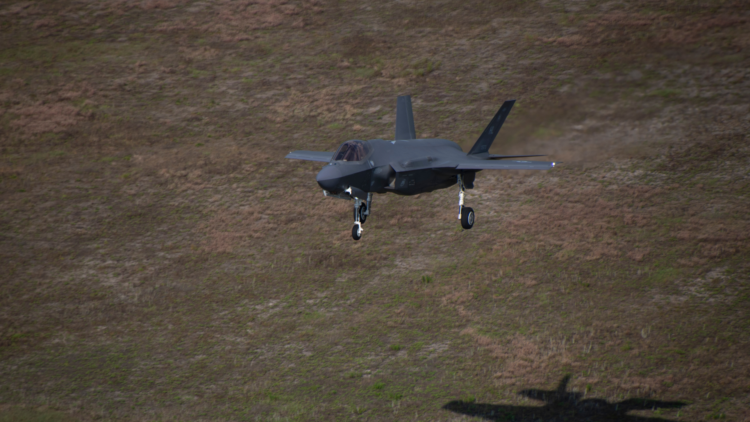
Unveiling the F/A-XX
The F/A-XX initiative represents a robust developmental and procurement program aimed at introducing a sixth-generation air superiority fighter.
Designed to replace the Navy’s F/A-18E/F Super Hornet and complement the F-35C in anti-access/area denial environments, this project was first launched in 2012 and is set to debut in the 2030s.
Moreover, the F/A-XX is the manned fighter component of the service’s Next Generation Air Dominance (NGAD) program, distinct from a similar NGAD initiative with the US Air Force aimed at replacing the Lockheed Martin F-22 Raptor.
As of writing, the technical specifications or detailed information regarding the F/A-XX fighter jet remained closely guarded by the US Navy due to its status as a highly classified program.
However, various reports and industry analyses have indicated the likelihood of advanced features.
The F/A-XX is expected to embody cutting-edge technology, potentially integrating supercruise capabilities, advanced stealth attributes, and a suite of adaptable, network-centric sensors.
Furthermore, the aircraft will likely be designed with enhanced avionics, next-generation radar systems, and a more sophisticated weapons suite.
Given the emphasis on next-generation air dominance, it is anticipated that the F/A-XX will push the boundaries of aerial combat capabilities while incorporating advancements in artificial intelligence (AI), unmanned systems integration, and state-of-the-art propulsion systems.
Lawmakers restored funding for the US Navy's F/A-XX and added language requiring cost and capability updates on both NGAD Programs 🇺🇸
Read the story by @ThrustWR 🔗👇https://t.co/AXsKhQWm8g— Naval News (@navalnewscom) December 11, 2023
Looking Beyond the Horizon
Moreover, despite maintaining secrecy around its NGAD development, the Navy has hinted at a comprehensive system, encompassing manned fighters, unmanned drones as “loyal wingmen,” and a suite of cutting-edge technologies, including a combat cloud.
Key missions encompass air combat, ground attack, surface warfare, and more, supported by state-of-the-art features like supercruise capabilities, advanced stealth attributes, and adaptable networking-centric sensors.
The Navy’s NGAD pursuit, although independent, aligns with the Air Force’s NGAD thrust, both aiming to redefine aerial combat capabilities.
These efforts are part of a broader global race towards sixth-generation aircraft, with similar initiatives underway in Europe, Russia, China, and Turkey.
The United Kingdom-led Global Combat Air Programme (GCAP) and the French-German-Spanish Future Combat Air System (FCAS) exemplify the international endeavor to push the boundaries of airborne dominance.
The Future Takes Flight
As the race intensifies for the first sixth-generation aircraft, the evolving landscape of defense technology remains shrouded in anticipation.
The convergence of AI, machine learning, advanced weaponry, stealth, digital design, propulsion, and thermal management underlines the transformative potential of these next-generation platforms, heralding an era where unmanned aerial systems exhibit autonomous capabilities while augmenting the efficiency of manned aircraft.
In conclusion, the imminent near-full funding of the F/A-XX program signifies a momentous leap in the trajectory of US Navy aviation.
As the boundaries of aerial supremacy are redrawn, the global pursuit of sixth-generation aircraft promises an era of unparalleled technological advancements, reshaping the future of military airpower on an international scale.
—
Disclaimer: SOFREP utilizes AI for image generation and article research. Occasionally, it’s like handing a chimpanzee the keys to your liquor cabinet. It’s not always perfect and if a mistake is made, we own up to it full stop. In a world where information comes at us in tidal waves, it is an important tool that helps us sift through the brass for live rounds.








COMMENTS