

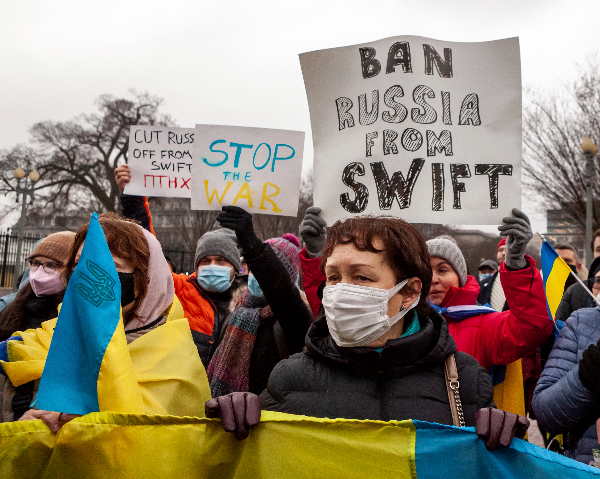
“As Russian forces unleash their assault on Kyiv and other Ukrainian cities, we are resolved to continue imposing massive costs on Russia. Costs that will further isolate Russia from the international financial system and our economies,” said the joint statement.
Specifically, they announced that selected Russian banks were to be removed from SWIFT, that restrictive measures were to be imposed on the Russian Central Bank in an attempt to disconnect the Russian financial system from the international financial system, making it difficult for the country to conduct business and raise funds. Furthermore, people and entities involved with the proliferation of the Russian aggression in Ukraine and measures preventing these people from becoming citizens of other countries were also pursued. Lastly, a transatlantic task force ensuring the effective implementation of the financial sanctions for individuals mentioned and their close allies and families.
Representatives from the SWIFT international payment system announced that they are making preparations to implement the group of nations’ new protocol, targeting specific Russian banks.
“We are engaging with the European authorities to understand the details of the entities that will be subject to the new measures, and we are preparing to comply upon legal instruction,” said their statement as reported by Reuters.
Just a day after the group’s decision, Japanese Prime Minister Fumio Kishida announced that they were supportive of the sanctions and that they are also committed to blocking particular Russian banks from the SWIFT payment system.
“This Russian invasion of Ukraine is a unilateral attempt to change the status quo and shakes the international order to its core,” said Kishida, who also called for unity and purposeful action against Russia. This decision was welcomed by the US ambassador to Japan Rahm Emanuel and the White House as part of the G7.
“Following Japan’s announcement, the entire G7 now supports disconnecting selected Russian banks from SWIFT, restrictions on the Russian Central Bank, and sanctioning key Russian leaders, including President Putin,” said Psaki in a statement. She also regarded Kishida and the Japanese government as leaders in condemning the Russian advance on Ukraine.
What is the SWIFT Payment System?
Founded in 1973, the Society for Worldwide Interbank Financial Telecommunications, otherwise known as SWIFT, is a trusted messaging service that supports over 11,000 financial institutions in over 200 nations and territories throughout the world. Its primary service is to provide a secure and efficient system that allows for rapid transfer of funds across international borders. The Belgium-based society is currently the most important payment messaging platform in the world, with nearly 40 million messages and trillions of dollars in transfers on the platform recorded daily in 2020.
Restricting Russia’s access to the network will yield a significant disruption to its economy as it severely dampens the country’s ability to access global financial markets. Having a ban on Russian banks will introduce challenges for Russian entities to send payments for imports or receive fund transfers for exports. This is expected to deal a definitive blow to the Russian oil and gas industry, which depends on SWIFT to transfer funds. Such restrictions also restrain the country’s capacity to borrow or send money abroad.
It is important to note that there are still viable alternatives to SWIFT. Russian banks could make transactions over the phone, use other messaging platforms, or utilize its state-created National Payment Card System in countries that have not yet agreed to impose sanctions. However, these second options are not nearly as efficient and secure as the previous system and will likely hike up costs and cut the number of transactions.
Why did the West hold back on SWIFT sanctions?
Whether they like it or not, European economies are tightly knit with the Russian economy and have a lot to lose in the event Russia gets banned from SWIFT.
Recent figures from the Bank of International Settlements (BIS) show that European lenders carry the bulk of exposure to Russia, particularly banks in Austria, France, and Italy. French and Italian financial institutions both had outstanding claims hovering around $25 billion in Russia in 2021, while Austrian banks held $17.5 billion, which is more than the $14 billion worth of claims for the United States.
Europe is also heavily reliant on Russia’s energy supply. The region gets over a third of its energy supply from Russia, and a SWIFT ban on the country could imply that importing countries will face difficulties in paying for their imports.
To mitigate the price hike on gas, some of these countries must seek alternative options. Germany, Russia’s biggest customer of gas in Europe, could try importing gas from Britain, Denmark, Norway, and the Netherlands, to name a few that are relatively close by. Southern Europe can obtain its supply from the Trans Adriatic Pipeline in Italy or through Turkey via the Trans-Anatolian Natural Gas Pipeline. The United States, which produces liquefied natural gas, can also ramp up production and increase exports to Europe.
Currently, the Russian ruble is feeling the effects of the SWIFT ban as the Russian currency plunged 30% against the US dollar after the imposition of the sanction. However, it was later stabilized by the Russian Central Bank. Despite this, the long-term effects of the SWIFT ban are yet to come as Russians may face higher prices for goods and services.
Tuning in to SOFREP for the first time? Click here and enjoy a free 2-month trial membership and be up to date with the latest developments in Ukraine and elsewhere around the globe.








COMMENTS