
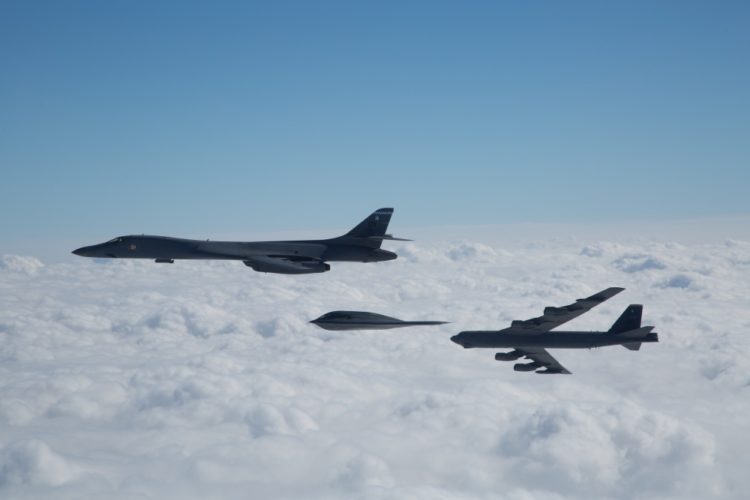

Crew Show
At this stage, aircrew members arrive and begin their walk-around of the bomber. One crew chief sullenly eyes the crew members doing the walk-around inspection, ready with a speed handle to tighten a fastener, open a panel to check servicing, or brain the crew member when he/she talks smack about the condition of the jet. The aircraft commander reviews the forms. The lead crew chief peruses the forms with the aircraft commander patiently sounding out the long words and explaining esoteric concepts like fuel load and weapons configurations.
Once these steps are completed, the pro-super takes one final look over the forms, noting any discrepancies he will have to address with the crew chiefs later in the smoke pit. When the bomber is deemed fully flight-worthy, the pro-super signs the exceptional release (ER) and relinquishes the aircraft to the flight crew. This is usually done with a firm “Safe flight!” and a surreptitious cross sign once the aircraft commander climbs the ladder to the flight deck.
Aircraft Engine Start

Once the aircrew is safely in their seats, auxiliary power units (APUs) startup to provide the forced air needed to start the engines. On good days, the APUs pop a burst of flame when they start freaking out new maintainers and flight crew alike. On bad days they spool up like a diesel turbo, cough, and die.
Once the APUs are running, the crew chief clears the area around the engines, and the pilot starts the first engine. Anyone who has heard the sound of a running B-1B engine knows the brain-liquefying sound of their banshee scream. Four engines operating at minimum power make the sound of ten million mosquitoes whining inside the ear canal. (Those engines have to be wrung out and checked for problems, and they are run through all power settings during those checks.)
When a B-1 engine is pushed into augmenter (afterburner for some folks), the exhaust nozzles do some cool movement, fuel is dumped into the exhaust, and four tails of blue flame make short work of any snowmen standing less than about 600 ft behind them. Your brain has already been liquefied from the banshee screams, but once the aug kicks in, it starts to run out of the ears. Any fillings you didn’t know you had vibrate loose and that titanium knee you just had installed sets up a resonating frequency. Your whole body is now trembling along with the dust and small animals kicked up by the noise and violence.
Maintenance Checks
During the engine run before launch, the aircrew runs up all systems and checks them for proper operation. On a perfect day, this takes about two hours. In reality, this can take upwards of four hours if problems occur. Maintainers remain on standby in the “launch truck,” waiting for the dreaded “red-ball” call that says something needs to be fixed. With luck, these red-balls will be minor and the jet will roll on time. They can be enough to cause a shutdown, though, which can jeopardize the entire mission.
The launch truck is made up of the A-team of maintainers, ready to repair any problem at the drop of a hat. Though a lot of tomfoolery and ass-grabbing occurs in these launch trucks, the denizens are consummate professionals, ready to do what it takes to make that aircraft flight-worthy — never mind that the expeditor promised them a bathroom break and lunch three hours ago.
The aircrew is now ready to release brakes and taxi out. All the maintainers in the vicinity are questioning the life choices that led them to this flight line.
Aircraft Taxi

Once the checks are complete, the crew is given permission to taxi out. A marshaller stands far in front of the aircraft, providing hand signals to show the pilots where to go. The pilots invariably ignore these signals and taxi and turn whenever and wherever they feel like it.
Somehow, the system works and the jet noisily trundles down the taxiway towards the runway. Maintainers walk around the spot the aircraft left, looking for anything that may have fallen from the jet during taxi. Fasteners, safety wire, or the lunch the expeditor promised them five hours ago. Finding none of these, they wait for the jet to take off.
Take-off
The jet taxies onto the runway, and the crew is arguing about who gets to pick the music for this sortie. That one defensive avionics guy wants to hear Highway to the Danger Zone and the other three are debating ejection. Clearance is given, the brakes are set, and engines are run to full-aug. Then back down again because one engine nozzle’s readings looked weird.
Engines are pushed to full-aug again, brakes are released, and the tail dips as each engine kicks out 30,000 pounds of thrust. All over the base, car alarms begin to wail. Small children cry and mothers curse. Jackrabbits in the infield pause in their chewing and look around.
The jet slowly begins its roll down the runway, four spikes of flame screaming out the exhaust nozzles. Maintainers wait with bated breath for the jet to clear the runway. They have crossed fingers, rubbed crucifixes, and shook chicken bones. The nose of the bomber rotates skyward, and the jet breaks the surly bonds and takes to the sky. The pro-super calls out “Bat 11, airborne.” Everyone sighs with relief, and the dance begins again.
After the thundering bombers have all departed, an eerie, lonely silence descends over the whole airfield.
Depending on the mission, the jet may return in four or five hours. Or it may return the day after, having flown all night to complete a bombing run on the other side of the world. Once it lands, the crew must be debriefed.
Maintenance Debrief

Once the engines are shut down, crew members head to the debrief room. Maintainers of all specialties meet there with the crew to talk over inflight discrepancies. Valid problems are noted in the aircraft forms and invalid ones are laughed out of the room. The aircrew then heads to Ops for their own debrief. Maintainers argue over who is responsible for the noted discrepancies and avionics always loses.
Maintainers gather tools and head to the jet, guys with high school diplomas head out to fix things designed by the guys with PhDs in Engineering.
Ops Debrief
Ops debrief is when the aircrew recounts the events of their mission. They discuss targeting issues, impressions of the AOR, and the fact the bomber still smells horrible from when “Biff” puked during last week’s high-G maneuver training. They complete paperwork, turn in their aircrew flight equipment, and trade stories and impressions with other aviators. Through this, they get a feeling about the jets and a better understanding of how to fly naturally and organically. Camaraderie is an important aspect of crew cohesion and leads to better overall flying. Also, it’s a good excuse to have a cold one with buddies at the end of the day.
The Pride at the End of the Day
All the events that were a part of that sortie take up a lot of time. Roughly 74 man-hours of maintenance are needed per one hour of flight time. B-1 bomber maintainers put in a lot of long days. During surge flying, maintainers work 12-16 hours a day to keep the jets turnin’ and burnin’. Pilots and aircrew members often spend double that amount in plannin’ and flyin’.
Though the days are long, the work nasty and thankless, and the pay seems like peanuts, there is pride in the faces of aircrew and maintenance alike. The “Bone” is an absolute beast, both good and bad. “She’s like dating a supermodel: sexy as hell, but so high maintenance you question whether it’s worth it,” a B-1 engineer once told me. The B-1 has a 30-year history of combat operations. Though it’s being phased out to make room for the B-21, it still has a future in modern warfare, at least until the B-21 is fully mission-ready. There are high hopes by the folks that work on these bombers that the B-21 will cut the wait time for a promised lunch from ten hours to a much more reasonable five hours.








COMMENTS