

“My First General Order Is…”

One of the first things a new recruit learns during boot camp is the “local” chain of command (DI, company commander, etc.) and then the chain of command of the Marine Corps leaders. There’s a good reason why they teach you this first.
We learn that if you need to go somewhere (like the doctor) then you had to first run that up your chain of command. Your direct supervisor would then approve the chit (paper request) and “send it up the chain.” It would travel up until it hit your officer’s desk. Now, here’s where the chain of command becomes very useful. Marines throughout the chain of command, from bottom to top, have the authority to approve specific items.
A Marine needing dental attention, for example, can be approved by his/her direct supervisor (fire team leader, squad leader, platoon Sgt., etc.). The only reason it goes a bit higher than that is so your unit’s boss knows your whereabouts when you’re absent from morning muster. It doesn’t go any higher than your direct supervisor for approval, only for information. You see, there’s this thing when sometimes Marines like to drink a little “kool-aid” and stay out until all hours of the night, totally ignoring the fact they have responsibilities only a few hours later. The officer in charge of the unit needs to know that you’re at dental, not AWOL. So, in short, the chain of command assists in keeping track of a fighting force.
If you’ve made it this far and you’re still wondering how exactly a chain of command works, it’s as simple as you might think. A servicemember has a request (leave/medical/dental/etc.) that they’d like approved. First, they complete a request stating the date(s) and time(s) they’re requesting away from the unit. Then, they submit your request to their direct supervisor who either signs off on it or denies it. If they deny it, the request dies there. If not, it continues up the chain until it reaches the highest person necessary for final approval.
It is very request-dependent, but for most normal requests the highest a chit would have to travel is to the officer in charge of your unit. For something more significant, like a promotion to “upper management” packet or a request for a change of duty station, the request will have to go significantly higher up the chain than is otherwise typical.
A Civilian Equivalent

For civilians who have never served think of it this way: You have a job flipping burgers at your local McDonald’s and you catch a cold. Who do you tell? You tell your direct supervisor, of course. You don’t need to tell them and then inform their boss or call the owner of the company.
Now, in this next example, you are still the 35-year-old burger flipper at the golden arches, but over the weekend you hit a $3 million Powerball and now you want to acquire your own McDonald’s franchise. You could still tell your direct supervisor about your aspirations, but they will no doubt just say something like “what do you want me to do about it. That’s above my pay grade.”
Of course it is.
You would need to submit a franchise application to someone higher up. It would be a waste of your time to submit that paperwork to your local manager; they just don’t have the authority to approve such a request. For this, you would simply let your chain of command know that you’d like to get an audience with the corporate office. They’d agree to the meeting and you’re set. You didn’t skip your local supervisors and you were able to speak to whom you needed.
A chain of command is all about every spoke in the wheel knowing their place and knowing what requests they can approve and what requests need to be carried further up the chain.
A Kink in the Chain
The final piece to consider about the chain of command is that if you feel as though your request hasn’t been properly considered, you are able to skip that link in the chain of command. Yet, let me first say this: if you purposely skip a link in the chain either for no reason at all or because you have a good feeling your supervisor will deny your request, you’re going to get your head ripped off. No, not figuratively; literally.
To be honest, though, that human link that you skipped can make your life pure hell for the foreseeable future. So, although it can be appropriate to skip one (or more) links in specific, unique circumstances, doing so without merit is very bad for your career and more importantly you’ll lose the trust and respect of your superiors.
The appropriate way to talk to someone higher up is to put in a request to your chain of command that you’d like an audience with someone further up. You don’t have to reveal your reason, but you do have to push the request through them to avoid the pitfalls of earlier-said decapitation.
Drinking in Proper Order
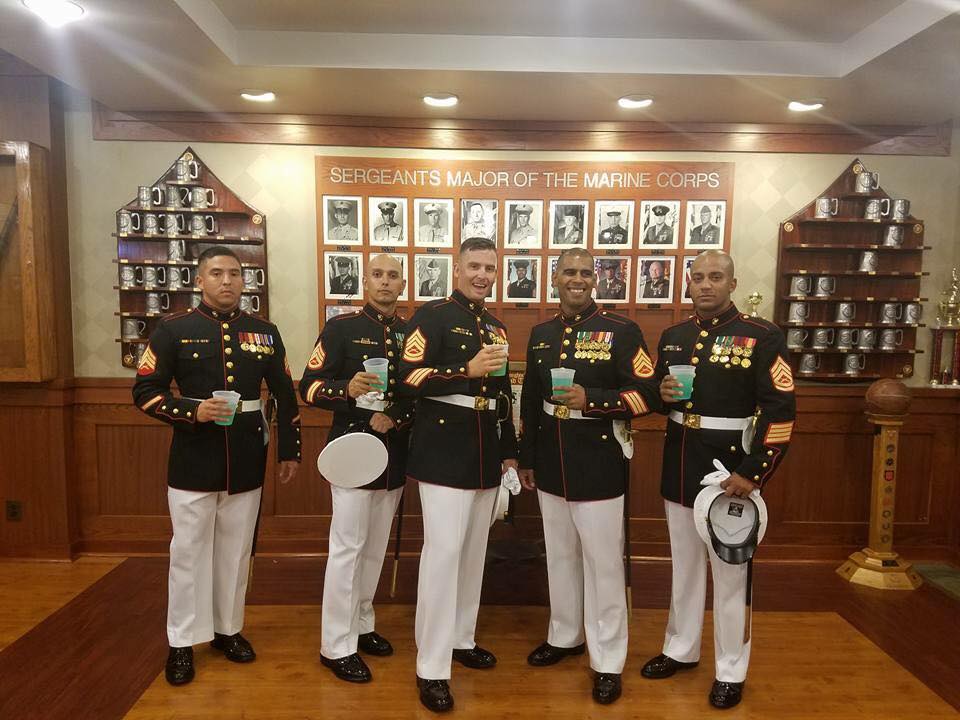
The night before writing this piece I spent time at the Staff NCO lounge at 8th and I Marine Barracks in Washington DC. The who’s who of Marine Corps leadership was there. Among them, the sergeant major of the Marine Corps, the previous two sergeants major, numerous high-ranking Marine officers, the drum major of the president’s own Marine Band, the drum major of the commandant’s own Marine Band, and dozens of sergeants major.
Even as someone who is well-versed in Marine Corps tradition, two major things stood out to me above all else. First, the decorum and camaraderie between Marines of all ranks were incredible to see. Second, there was inside that club a chain of command for the customized pewter heritage mugs the high-ranking staff drank from. If you’re having trouble picturing this, don’t worry, I too was amazed. (You can see the cups in the photo above.)
On the far wall of the room were shelves containing these pewter mugs, arranged in order of authority or chain of command. Since the sergeant major of the Marine Corps is the highest-ranking enlisted person in the Marine Corps, his glass sat atop the bunch. The chain of command is so important within the Marine Corps that even the way Marines drink adheres to it. And for those wondering, yes, they do actually drink out of them. They’re Marines after all so it may just be melted crayon wax that they’re consuming from the mug, but who am I to judge.
To sum it up, the chain of command structure is imperative for any properly functioning business. And for the military, it is absolutely essential. Owners of large companies don’t order toilet paper and Marine PFC’s don’t control the nuclear football. You submit requests to and receive orders from your direct supervisor. Everyone has his or her place, and it is perfect that way.








COMMENTS