

🇸🇪🇺🇦 pic.twitter.com/lu4e1CA5Im
— Visegrád 24 (@visegrad24) June 2, 2022
Their rhetoric in the recently released statement is perhaps another aspect to analyze:
“The Russian invasion of Ukraine is unprovoked, illegal, and indefensible. It threatens international peace and security and is a violation of international law. In solidarity with Ukraine, and as part of the international response to Russia’s actions, the government sees a continued need to support Ukraine.”
Here we definitively see the stark difference in their words before the invasion, a sign that they are leaving their neutrality and non-aligned beliefs behind, a stance they adopted last 1939. However, this is not the first time they have sent aid to Ukraine. Early in February, the Swedish Government sent $95.9 million to Ukraine. They have also sent 50.5 million to Ukraine’s Central Bank in the past, with another $58.4 million proposed to be donated.
Why is the Robot 17 Anti-Ship Missile Important for Ukraine?
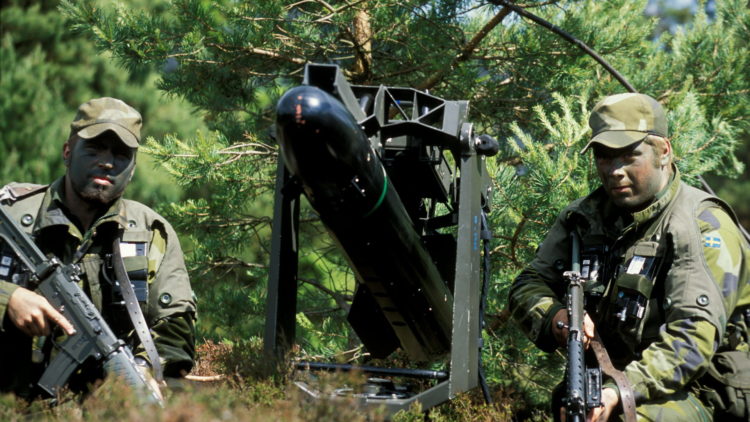
The Robot 17 is a Swedish anti-ship missile made by Bofors and is known for its precision. It is essentially a modified version of the American anti-tank missile AGM-114C Hellfire. As we all know, the AGM-114 Hellfire is an air-to-surface missile mostly used for land-attack missions and is often seen as an air-launched missile (seen mostly on attack helicopters).
The Swedish developed it further so it could be launched against sea targets and fired on land, as a coastal defense system. First unveiled in the 1980s, the Robot 17 is man-portable, making it easier for the Ukrainians to carry and position, firing at enemy vessels from the shores or even aboard a naval vessel.
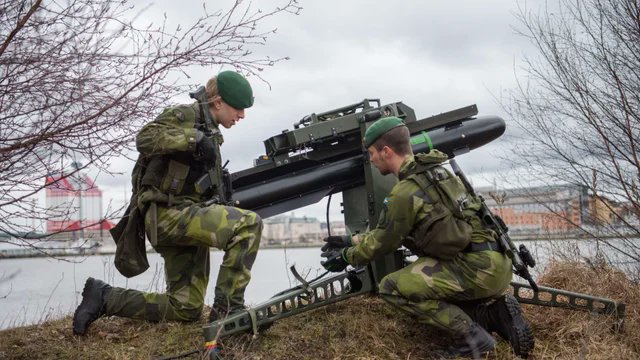
If ever the Russians attempt an amphibious landing on Ukrainian shores along the Black Sea, the Robot 17 could be employed against landing craft and barges offshore, which might be enough to deter Russia from even trying.
The Robot 17 can fill a gap with previously sent (and promised) anti-ship missiles. Ukraine’s Neptune anti-ship missiles were used to sink the Russian flagship of the Black Sea Fleet the Moskva has an operational range of 170 miles. The United Kingdom’s donated Brimstone missiles have a reported medium range of somewhere between 12 to 37 miles, and the Harpoon anti-ship missiles have an operational range of 75 nautical miles. So Robot 17 can fill the gap as the Harpoon and Neptune missiles cannot be fired close range.
Ukraine’s successful sinking of the cruiser Moskva with the Neptune anti-ship missile and the arrival of Harpoon missiles from the UK, Denmark, and Netherlands would give pause to any Russian plans to make an amphibious landing along Ukraine’s coast. The three missile systems used together, give Urkaine long, medium, and short-range strike capabilities on any Russian ships attempting to approach the coast. More so, once the Ukrainian forces fire, the Ukrainians can move and reposition the launcher elsewhere so they can evade counter-attacks from the Russians. It is a laser-guided system equipped with a 20-pound warhead with an effective range of some 5 miles. It would not be enough to sink a large vessel but would wreak havoc on smaller landing craft and gunboats. It would also be able to badly damage a larger landing ship if the Robot-17s were fired at it in large numbers. A twenty pound explosive charge is pretty significant and these vessels are unarmored.
It is important that Ukraine is armed with these weapons as TASS recently reported that there had been a large grouping of 12 landing ships ready to take part in the so-called “special military operation.”
“For the first time, such a large grouping of the Russian Navy operates in the Black Sea, which consists of twelve large landing ships of the Northern, Baltic, and Black Sea fleets,” the outlet said, citing a source within Crimean authorities.
“These BDKs (large landing vessels) are now ready to perform their intended tasks as part of a special military operation.”








COMMENTS