

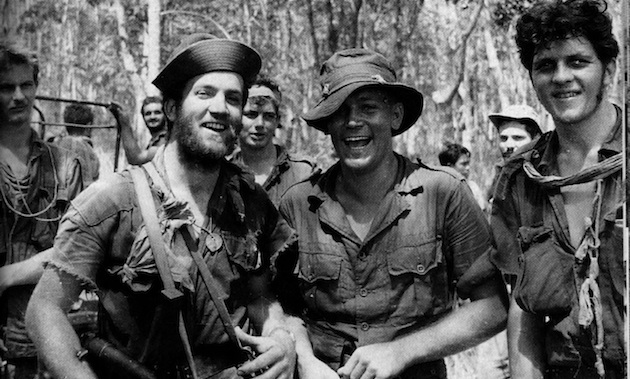
The remaining weeks of Phase I would focus on the individual. Since operators function deep behind “the lines,” the small team and individual aspect is critical. The remaining candidates would embark on a five-day test across mountainous terrain to prove their endurance, bushcraft, and mental/physical toughness. Like the Rhodesian Scouts’ selection, candidates would begin the evolution with a 66-pound rucksack and be provided with a 63-mile course to be completed (individually) in a given timeframe with frequent check-in by instructors. Following the individual ruck-marching portions, the remaining candidates (as a group) would be exposed to heavy doses of sleep deprivation, PT, and mind games. The final weeks of the phase leading up to the five-day challenge would incorporate strategies used by all SOF training schools to “weed out” those unfit to serve with the Scouts.
Phase II: Small-Unit Tactics
After completion of Phase I, the whittled-down class would move to terrain that best resembles their future areas of operation (desert, jungle, mountains, sub-arctic, ect.) and remain there for the duration of their training. At this point, the physical grind would be adjusted to focus on the rigors of long combat patrols, firefights, and other small-unit maneuvers.
This phase would incorporate many lessons from Special Forces’ “Robin Sage” exercise, as well as other elements of the “Q Course.” Most importantly, candidates with military or SOF experience would be responsible for training their classmates. Though foreign internal defense (FID) is not a direct operational skillset for the Scouts, they will eventually need to replicate the same training with indigenous forces and former insurgents who will be incorporated into their teams. All candidates would be expected to demonstrate their abilities as teachers and trainers.
The final weeks of Phase II would be dedicated to the study and perfection of guerilla tactics. Candidates would be indoctrinated in the ways of guerilla warfare from Francis Marion and the Boers to the Viet Cong and the Mujahideen. Classroom lessons would later be carried out in the field. Scouts would also learn the basic elements of insurgent propaganda and its applications in previous insurgencies. Scouts would not only pretend to be guerillas, they would become pioneers and innovators in the field of insurgent warfare. This mindset would keep them ahead of the enemy but also allow them to advise conventional forces with “red-teaming” of their defenses and unconventional thinking.
Phase III: Dark Phase
During the longest and perhaps most mentally challenging phase, candidates would transform into insurgents. Plucking lessons directly from the Rhodesian Selous Scouts curriculum, Scout instructors would lead candidates through exercises to sharpen their ability to blend in with the enemy and “learn the part.” Freshly gathered intelligence on insurgent training, indoctrination, and mannerisms (eventually from Scout sources) would guide this schooling.
The ability of an operator to observe and emulate social and cultural cues is as critical as his aptitude for eating rancid monkey flesh or laying in ambush for hours. This skill is akin to a twenty year old from California being able to discreetly enter a bar in Boston and slip out with everyone convinced he is straight out of “Good Will Hunting” (apologies to true Bostonians who hate this analogy).
For Rhodesian Scouts, playing the “camp side” of the rebel was sometimes fun. When entering an African village, pseudo-guerillas would be fed well by villagers (often after demanding it in brutish fashion), drank local spirits, cavorted with village women, and joined in festivities with their insurgent “brethren.” They did this because they were “playing the part” of guerilla and that was how the rebel groups acted.
Likewise, American Scouts would need to learn the cultural passions, interests, social graces of their jihadist prey. Just as Rhodesian Scouts learned to sing rebel songs a capella in case they needed to join in chorus with the insurgents, American Scouts would need to learn the mannerisms and practices of Islamic prayer as well as social gestures. If an ISIS commander noticed a group of insurgents praying in the opposite direction of Mecca, he would have good reason to be suspicious.
Rhodesian Scouts went to great lengths to learn the “call signs” and communication techniques of their enemies, especially in instances where they needed to lure their victims closer. American Scouts would similarly acquire the proper communication protocols (mobile phone, radio, social media) and gather additional intelligence to keep protocols current.
In addition to communication, Scouts would receive specialized training in creating social-media campaigns to boost their insurgent credentials. This would build off of their earlier propaganda training, but would introduce candidates to colloquial language and social-media technologies. Complementing the Scout’s “tracker ethos,” candidates would be taught to track their enemies on social media, probing for vulnerabilities and trying to lay “cyber ambushes” to facilitate real ones.
Language skills would become increasingly critical for the remainder of the course, as Scouts would be further exposed through course study as well as through the immersion method. A final cumulative exercise would test the Scout’s proficiency before graduation and pre-deployment to teams with assignments for follow-on training.
Specialty Training
Like a Special Forces ODA, each member of the Scout team would receive training in one primary and one secondary specialty:
| Primary Specialty | Secondary Specialty (Suggested) |
| Engineer/Weapons: Focus on foreign weapons systems, IED tactics/technology, standard combat engineering (building), demolitions, basic EOD and attacks on insurgent infrastructure. | Medic |
| Communications/Social Media: Focus on insurgent radio/communication systems, social-media propaganda, social-media contact with insurgents, and cyber ambushes/intelligence collection. | Engineer/Weapons |
| Linguist/Intel: Focus on fluency/cultural competency in target language and interrogation practices. Intelligence collection and analysis of insurgent activity and operational planning against targets. | Communications/Social Media |
| Medic: Graduate of 18D Special Forces Medic course. | Linguist/Intel |
Scouts would generally operate in four- to five-man “sticks,” with three sticks comprising the “platoon.” Cohesiveness within the platoon would be strong since most training would be conducted at the platoon level, but operationally the sticks would function as their own units—collecting intelligence/reconnaissance and conducting direct-action operations against their foes.
Parachute training, in keeping with the Rhodesian tradition, would be another staple of the Scouts’ arsenal. Trained in both HALO and static-line jumping, Scouts would be able to insert deep behind enemy lines, even using low-quality transport aircraft supplied by indigenous forces. Scouts would also learn helicopter air-assault tactics, training on both American and local helicopters alike. Quick infiltration and exfiltration by air would be critical in pseudo-operations where Scouts could easily find themselves outmanned and outgunned.
Waterborne insertion may sound irrelevant given ISIS’ primarily landlocked center of gravity, but the possibility of inserting Scouts along the Syrian or Lebanese coastline must be accepted as a potential reality. Newly minted Scouts who had not previously attended amphibious raiding or combat-swimming training would attend a customized course similar to the USMC’s Basic Reconnaissance Course to be familiarized with waterborne insertions, scout swimming, and small-boat operations.
Depending on the need for Scouts to start using SCUBA and closed-circuit diving to insert into their AO, (non-dive qualified) Scouts would attend the U.S. Army’s Combat Dive Course. Scouts would maintain combat swimming skills for infiltration and exfiltration only, leaving maritime special operations to units with a maritime-centric responsibility.
The goal of the Scouts’ selection and training pipeline would be to identify tough, resourceful men by subjecting them to superhuman physical training under the dire conditions of starvation, cold, and sleep deprivation, instilling in them the “tracker ethos.” Candidates would then be introduced to pseudo-operations in “dark phase,” emphasizing cultural competency, social assimilation, and language skills. The curriculum would stress the constant need for assessment and learning, modifying skills and tradecraft as insurgents continue to grow and adapt. Though similar to other SOF pipelines and schools, the “tracker ethos” and emphasis on “playing the part” would set this selection apart from the rest.
(Editor’s Note: This post was written by Applied Memetics Staff—@appliedmemetics)
(Featured image courtesy of aventuresdelhistoire.com)








COMMENTS