

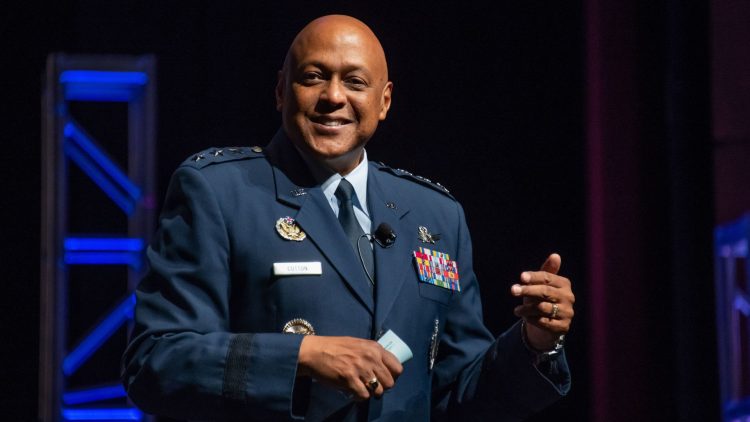
We’re still relying on a “legacy system” created for the Soviet threat, Cotton said, acknowledging that while the triad remains “safe, secure, and effective,” it’s time to address its aging infrastructure.
The goal, he explained, isn’t just to replace outdated systems but to build flexibility into the modernization program so the US can adapt to evolving threats over time.
“It’s really hard to convince folks [that] you need to modernize” when the systems work, Colton explained. “I’m sorry we didn’t think about [modernization of the triad and communications system] 30 years ago, so here we are.”
—-cited from USNI News
The Role of AI: A Helping Hand, Not a Decision-Maker
One of the more intriguing parts of Cotton’s discussion centered on the role of artificial intelligence.
Let’s face it—AI has become a buzzword in nearly every industry, and the military is no exception. But in the context of STRATCOM, its potential applications are both promising and sensitive.
Cotton explained that AI can help sift through the “terabytes of data” generated by intelligence, surveillance, and reconnaissance (ISR) systems. By automating data analysis, AI can save time and help commanders understand the status of their forces more efficiently.
This means decisions—like providing the president with actionable options—can be made in minutes instead of hours.
But here’s where Cotton drew a hard line.
While AI can make processing data faster and smarter, it will never replace human judgment when it comes to nuclear weapons.
Referencing the 1983 movie WarGames, where an AI system called WOPR takes control of the US nuclear arsenal, Cotton dismissed any comparisons.
“We do not have a WOPR at STRATCOM headquarters. Nor would we ever have a WOPR at STRATCOM headquarters,” he said. “Nor would we ever have a WOPR in STRATCOM headquarters.”
This stance aligns with a recent agreement between President Joe Biden and Chinese President Xi Jinping that emphasized the need for human control over nuclear decision-making.
Cotton doubled down, saying, “Advanced systems can inform us faster and more efficiently, but we must always maintain a human decision in the loop.”
Challenges Ahead
While the need for modernization is clear, it won’t come cheap.
Cotton estimates the cost of modernizing the nuclear enterprise to be 4 percent of the defense budget, which has spread out over decades.
He paraphrased former Defense Secretary Jim Mattis to drive home the point: “We can afford survival.”
The challenge, Cotton noted, is convincing people of the need to upgrade systems that, on the surface, still appear to work just fine.
“I’m sorry we didn’t think about [modernization] 30 years ago,” he said.
Reassuring Allies
In addition to addressing the triad’s future, Cotton stressed the importance of maintaining “extended deterrence” for US allies like South Korea and Japan.
Constant engagement, he explained, reassures allies that America has their back.
Recent examples include port calls by ballistic missile submarines in Busan and joint air exercises with Korean forces.
“Gone are the days of thinking a [North Korean attack] will never happen,” Cotton said, highlighting the growing importance of these alliances in a volatile global environment.
You can rewatch General Cotton’s CSIS livestream discussion below.
Final Thoughts
Gen. Cotton’s remarks reflect the balancing act required to maintain a strong, modern nuclear deterrent while adapting to new threats and technological advancements.
Modernization is critical to ensure the US stays ahead of adversaries, but it must be done thoughtfully and carefully—especially when integrating tools like AI.
At its core, America’s nuclear strategy remains the same: deter adversaries by showcasing readiness and capability.
But with shifting global dynamics and rapidly advancing technology, the path forward requires both innovation and vigilance.
As Cotton put it, “We can afford survival.” That’s a message worth taking seriously.








COMMENTS