

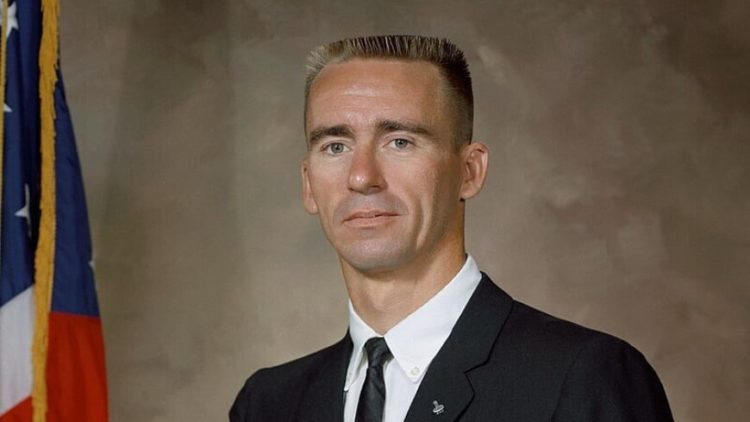
Following the passing of the original “Mercury Seven” astronaut and Apollo 7 mission commander Schirra in 2007 and command module pilot Eisele in 1987, he was the sole remaining crew member of the mission.
Cunningham was assigned to be the lunar module pilot for the flight of Apollo 7, although it had no lunar module, and he was responsible for all the operations of the spacecraft, apart from the launching and navigation.
“He was the second civilian in space, after Neil Armstrong, who had flown in the Gemini program and later became the first man to walk on the moon.”
His Brave Apollo Mission
On October 11, 1968, Apollo 7 took off from Earth, signifying the return of NASA’s lunar mission after the tragedy of the Apollo 1 crew – consisting of Gus Grissom, Ed White, and Roger Chaffee – in late January 1967, when a fire broke out during a pre-launch practice.
Before he was appointed to Apollo 7, Cunningham was the alternate lunar module pilot for the unfortunate Apollo 1 mission, and he was part of the main crew for Apollo 2 until it was called off.
Apollo 7 made history when it became the first mission to broadcast the crew’s activities live on television.
Additionally, the astronauts encountered some difficulties during the mission, as they had colds and frequently expressed their displeasure with the mission directors.
Tensions between the three astronauts led to them never venturing into space again, even though Schirra had already declared his intention to retire after completing two missions for NASA.
Despite this, the mission was deemed to be a success from a technical standpoint, verifying the dependability and soundness of the systems that propelled Apollo 11 to the moon in July 1969, which allowed Neil Armstrong and Edwin “Buzz” Aldrin to make their significant first steps on the moon’s surface.
Cunningham had a long career with the United States Navy and Marine Corps, having flown 54 combat missions prior to his retirement as a colonel. NASA selected him in 1963 to be part of their third astronaut cohort.
After completing his military duties, Cunningham served at NASA for some time, followed by three years with the Rand Corporation as a scientist. His work at the Rand Corporation included doing classified studies in the area of defense and researching the Earth’s magnetic field.
Bill Nelson, NASA Administrator, stated in a statement announcing Walt Cunningham’s passing that he was a combat pilot, scientist, and businessperson, but most of all, an adventurer.
After Apollo 7, Cunningham was put in charge of the Skylab branch of NASA’s flight crew directorate, a program focused on creating an early space station. Cunningham retired from NASA in 1971.
After retiring from NASA, he pursued a career as an investor and corporate leader in multiple business endeavors and became a popular keynote speaker and the host of his radio show.








COMMENTS