

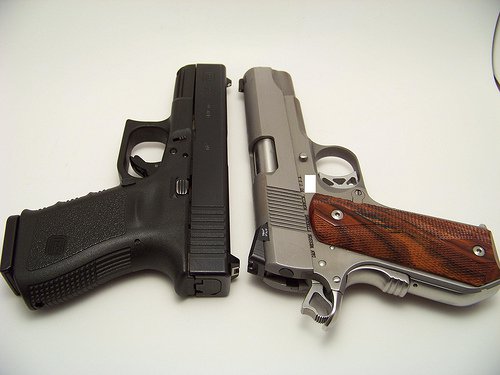
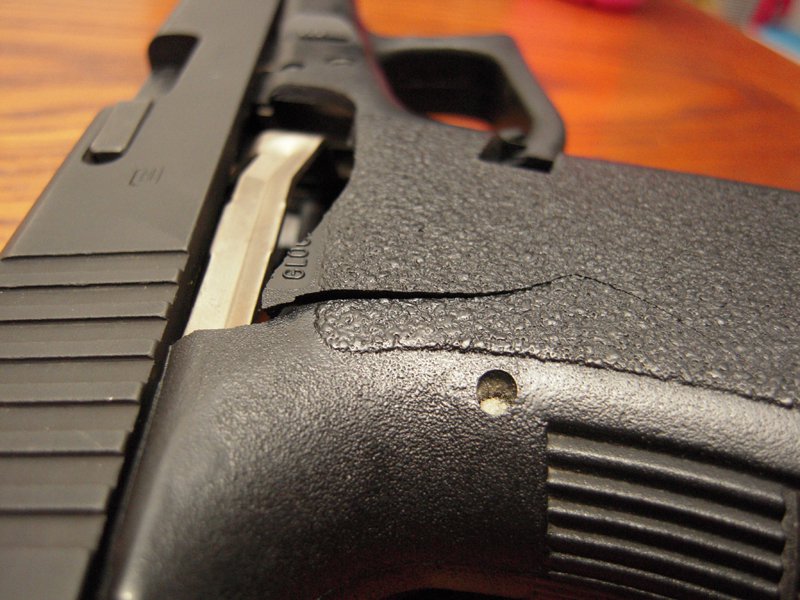
- Immediately incapacitate a threat?
- Eventually incapacitate a threat?
- Slow down a threat?
- Render a person less able to remain a threat?
- Knock the threat to the ground?
Let me start by saying this: ” The .45 cal has no more “knockdown power” than a 9mm.” Before a huge argument starts on this topic, take a look at my reasoning behind this statement, as I will use physics and real-life experiences.
We know that the equation for kinetic energy is KE = ½mv2 (KE is kinetic energy, m is mass of object, and v2 is velocity squared). This equation tells us how much energy will be derived from a combination of bullet grain weight and muzzle velocity.
Contrary to what some may think, the 9mm has more kinetic energy than the .45 cal. all due to the 9mm higher muzzle velocity. Don’t get too excited those not in favor of the 1911. Being that the 9mm’s muzzle velocity is greater than the slow .45, it increases the chances of the projectile fully penetrating a soft target, thus not allowing the full transfer of kinetic energy, hence the Taylor Factor.
The Taylor Factor: Even though the 9mm has more energy, its smaller bullet and higher velocity make the transfer of energy less efficient, meaning the 9mm is much more likely to penetrate FURTHER but does LESS DAMAGE along the way than the .45acp. The Taylor factor describes how well a bullet transfers its momentum/energy to the target. A 9mm has a Taylor factor of 7.29, while the .45acp has a Taylor factor of 13.37, meaning the bigger diameter .45acp is nearly TWICE as effective at transferring energy to the target. Advantage: .45acp
In my experience operating as an assaulter, machine gunner, and sniper, I am 100% positive that high velocity (2650+ fps.) and large mass wins every time. With that said, I have also seen and engaged targets with .308 projectiles moving at 2650 fps. and the target needed more than one round to incapacitate. Why is this? We can sum all of this up by saying one thing. Shot placement is the only true “Stopping Power.” A good friend of mine and former Army Ranger was shot in the upper shoulder with an AK-47 and continued to fight, killing the insurgent with a well-placed round center mass with his 5.56.
Myths
Some of the best myths I’ve heard have to come from the Glock owners (we will address the 1911 myths as well, don’t worry). Let’s look at a few of what I believe to be some of the best myths to come out of the Glock community.
Glock Myths
- Glocks Shoot well underwater. This is somewhat true. Yes, they do shoot underwater at times, but just because they shoot underwater, it serves no real purpose to the shooter, especially being that the round drops to the ground at about the 3 or 4-foot mark. Don’t expect the weapon to dump an entire mag consistently while submerged.
- They work even when they are filled with dirt and mud. This is false. Any weapon that has moving parts WILL malfunction at some point when a foreign object is introduced and interferes with the moving parts.
- Glocks are not accurate compared to the 1911. NOT true. At 25 yards, they shoot just about the same MOA. Shooters typically display poor skills in one area or another when comparing. One of the major issues I see is trigger pull and anticipation.
1911 Myths
- 1911’s shoot better. NOT true. Refer above. Also, note that the 1911 owners favor the trigger over the Glocks slack and break.
- 1911s are one-hitter quitters. This is not true. Just because a 1911 is a large caliber does not mean it will immediately stop an aggressor.
Hand Angle and Sight Picture
Some 1911 owners say that the Glock’s frame structure prevents them from getting high enough on the pistol’s grip/tang to control recoil properly. This all depends on the shooter’s hand size and whether or not the shooter is using a proper shooting grip. 1911 shooters have somewhat of an advantage with the 1911 pistol’s frame, enabling the shooter to get extremely high and strong on the tang, which I absolutely love.
Conclusion
I personally love both weapon platforms; they are both great tools. If you are looking for a weapon with history, fun to shoot, a good starter pistol, and basic home/self-defense, the 1911 is a great choice. If you are starting off with pistol work, the simple fact that the 1911 has a safety is a plus for me. Sure, the Glock has a safety, the trigger, but I have seen too many times people who are inexperienced negligently discharge the weapon.
As for self-defense, I would have to go with the Glock. The variety they can come in and the fact that they hold more than 7 rounds in the magazine is a plus for me. Sure, .45 cals leave a big hole in soft tissue, but under stress, how accurately can you place that one or two rounds into a target, or what if the time comes when you may need to engage 3 targets? Typically, I train to shoot no less than 3 rounds in a target center mass, no matter the circumstance, environment, or stress level. Having a 7-round magazine and 3 targets, I suggest training to get your reloads under 2 seconds, under any condition.
This article was written by








COMMENTS