
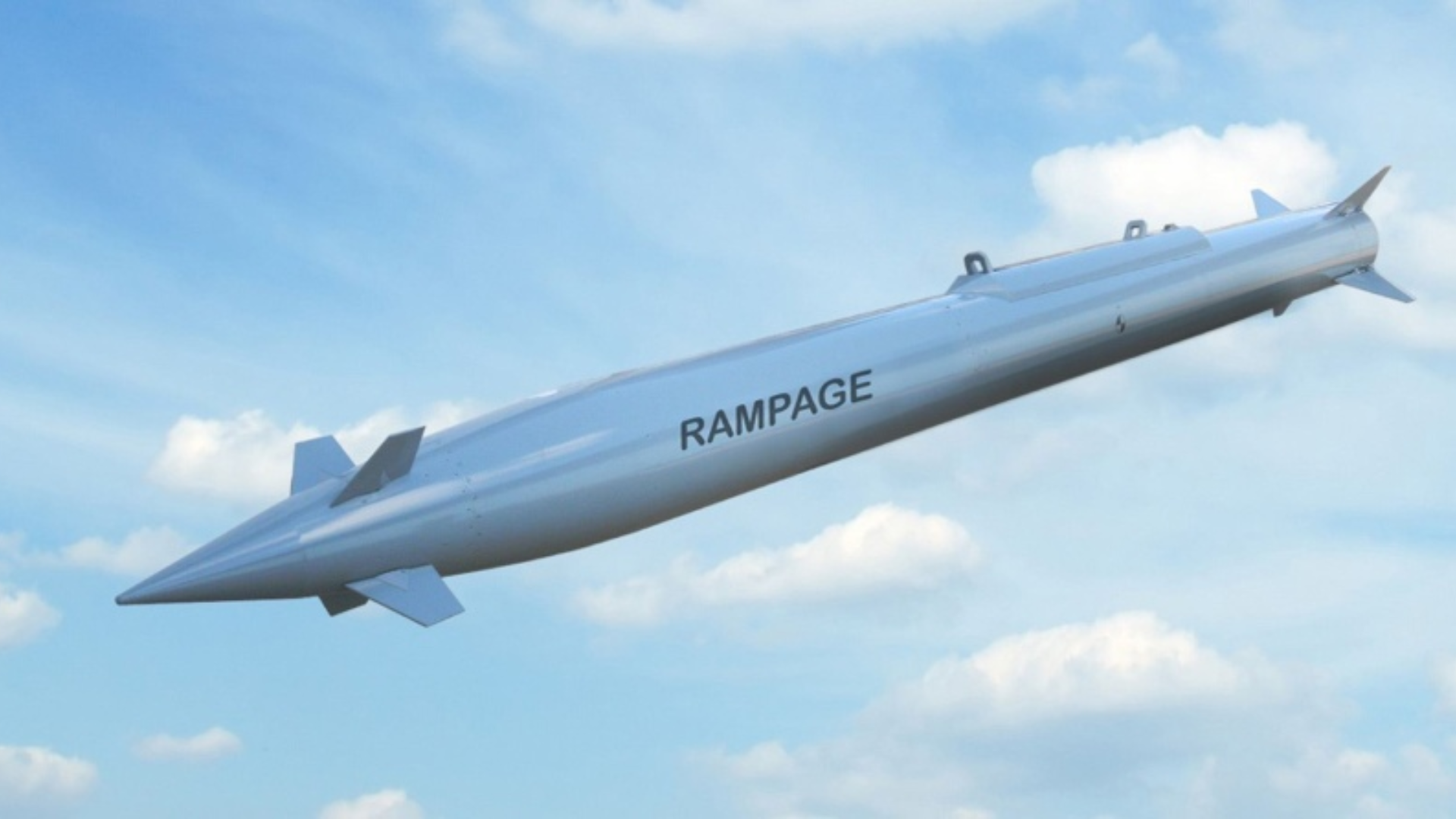
Its extensive range enables launch beyond the engagement range of many short- and medium-range air defense systems, heightening host aircraft survivability significantly.
Additionally, its swift velocity renders it suitable for striking time-sensitive targets, potentially including mobile air defense systems or ballistic missiles, provided target coordinates are established promptly.
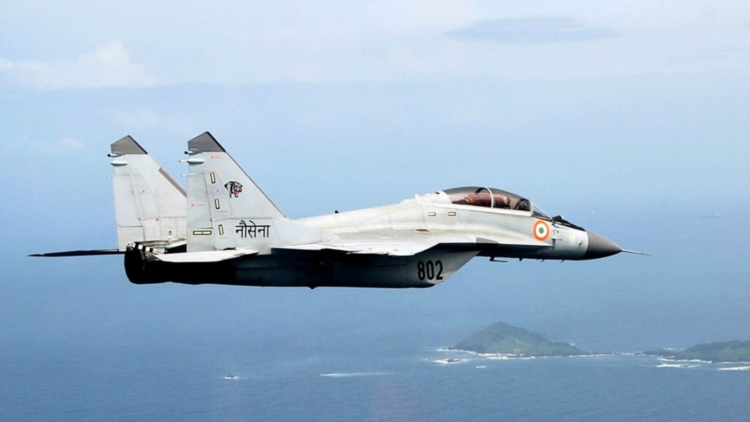
Rampage Air-to-Surface missile on #IndianNavy's MiG-29K fighter aircraft. pic.twitter.com/lEM5CXdr0e
— News IADN (@NewsIADN) December 3, 2023
Other typical targets listed include fixed and time-critical targets, air force bases and other military installations, munition storage, air defense sites, logistic centers, and communication centers.
The precision-guided weapon can also penetrate essential infrastructure facilities, such as power plants, ports, and oil fields, to name a few.
Notably cost-effective compared to conventional air-launched standoff weapons, the Rampage missile’s integration onto diverse combat jets, including India’s mixed fleet of British, French, Russian, and domestic aircraft, showcases its versatility.
Strategic Significance: Rampage in Action
In an in-depth overview of the Rampage missile, The War Zone has cited the 2019 Balakot confrontation as a pertinent example illustrating the precision-guided weapon’s potential utility for India.
In February 2019, India launched a bombing raid in Balakot, Pakistan, against an alleged terrorist training camp.
While India claimed to have wiped out a “large number” of terrorists from that area, analysts who reviewed multiple open-source satellite imagery said the Indian fighters that crossed the de facto border in the disputed region of Kashmir “did not hit any targets of significance.”
Payload of hastily escaping Indian aircrafts fell in open. pic.twitter.com/8drYtNGMsm
— DG ISPR (@OfficialDGISPR) February 26, 2019
Regardless, in that incident, the Rampage’s capability to execute airstrikes from within Indian airspace, offering considerable standoff distances, could have significantly altered the outcome.
Furthermore, the Rampage’s adaptability for urban scenarios minimizes collateral damage, making it a feasible option for precision strikes in such environments.
Despite its efficacy against fixed targets and hostile air defenses, it lacks suitability for engaging moving targets like warships.
Rampage Missiles: Integration and Future Prospects
India’s procurement of the MiG-29K/KUB fighters, totaling 45 aircraft, marks a significant milestone, albeit amidst challenges related to maintenance and serviceability.
Plans to replace these with the Dassault Rafale M as the next carrier-based fighter underline India’s commitment to modernizing its fleet.
Moreover, unconfirmed reports hint at the Rampage’s potential integration onto other Indian Air Force platforms, including the Su-30MKI Flanker and MiG-29s, emphasizing its expanding role in bolstering India’s air-launched standoff strike capabilities.
Conclusion: A Game-Changer in India’s Defense Strategy
In the face of formidable adversaries with robust air defenses, the Rampage stands out as a cost-effective solution, augmenting India’s aerial combat prowess.
As its integration onto more platforms looms, attention turns to potential export customers and the missile’s evolving role in modern warfare.
India’s development and deployment of the Rampage missile herald a new era in the nation’s defense strategy, showcasing its commitment to leveraging cutting-edge technology to safeguard its sovereignty and national interests.
—
Check out:










COMMENTS