

Supply issues will be present in the West, yet they are more manageable due to the Rammstein coalition’s GDP being more than 100 times greater than Russia’s. Consequently, they are economically better prepared for a prolonged conflict than Russia.
As to who will emerge victorious, he cannot say. War is much like a football match – many may hope for Brazil to triumph, yet they do not always come out on top.
Putin’s Decision
Felgenhauer suggested that a military objective was to prevent the possibility of Western missiles being placed in Ukraine to launch an attack against Moscow.
The primary purpose was to bring together Russians, including those living in Ukraine, and to demonstrate their defiance to the West, thereby weakening its unity.
The Western alliance aims to create tension and establish a multipolar world.
Due to various factors, there was the assumption that the Russian army was powerful enough to easily win the battle, bringing many advantages in economy, politics, and global influence. Therefore, people believed this was the ideal situation to take advantage of.
Because of this, the Russian military appears not as potent as its leadership, and the West had initially assumed. As a result, it needs to prepare for contemporary warfare.
The Ukrainians had a clear advantage over the Russians in terms of preparation and command, not to mention the weapons they had access to. These factors gave them a much greater chance of success.
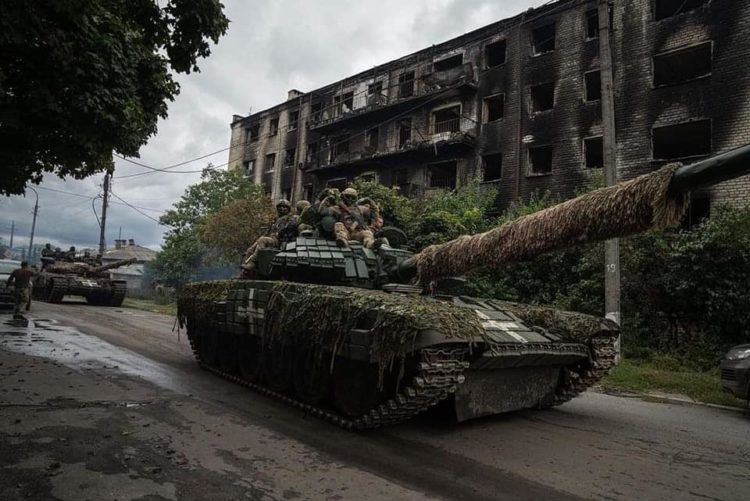
The Russian military has been cut off from global warfare trends for over a century. They continue to rely on a large number of tanks for success, believing this will guarantee them a win.
On Thursday, December 1, 2022, Elizaveta, aged 94, was taken on a cargo cart to an evacuation train in Kherson, Ukraine, as captured by Evgeniy Maloletka’s photograph.
The conflict caught them unaware, as they had not been able to ready themselves intellectually, emotionally, and physically.
Where are they now…? 🤔
Russian military vehicles entering Makarov (Kyiv region) a year ago. #Ukraine #RussiaInvadedUkraine #Russia #UkraineWar #ukrainewaranniversary #RussiaIsLosing pic.twitter.com/EkoS2P4f6w
— Natalka (@NatalkaKyiv) February 24, 2023
Those in the Russian military who were against the idea of invasion warned that it would be met with a great deal of resistance from Ukrainians, who were well-equipped with forces and support from the West.
Those in the highest echelons of government were living in a fantasy world.
Felgenhauer: The breakup of Ukraine and Russia after the fall of the Soviet Union was a harrowing event for the Russian elite, who believed that Ukraine was an integral part of their country. It was often said that, in the end, the two nations would reunite and form one sizeable Russian family. In the 1990s, officials assured Pavel that even with the current negative birth rate and declining number of Russians, this could be easily remedied by incorporating a large portion of Ukraine, Belarus, and Kazakhstan, which would add 40 million Slavic people to the fold.
It was not seriously believed that Ukraine would break away from Russia and become a completely sovereign nation. For a short period of time, but not permanently.
What is the current opinion of Putin on this topic?
Felgenhauer: Putin has declared that a Ukraine with a certain degree of autonomy is acceptable, provided it has some political association with Russia.
Ukraine’s membership in the European Union and NATO is something that Russia disagrees with. It was thought by many in the region, including Russian speakers and Ukrainians, that Ukrainians were not in favor of NATO membership until recently. Therefore, Russia attempted to hinder Ukraine’s integration into European and Atlantic structures, primarily NATO.
Felgenhauer also added that there are particular military explanations.
Since the days of the Cold War, the Russian military has had the belief that the West was getting ready for what they call a decapitating attack. The idea is that in the event of any conflict between Russia and NATO or the US, the attack would be initiated to destroy and disable the Russian leadership physically. Their strategy is to cut off the head of the country and then put an end to the disorganized resistance.
As a result of the West’s development of the necessary capabilities, the 1980s saw the missile crisis in Europe; the Americans had armed ballistic missiles that had pinpoint accuracy and could reach Moscow from Germany in a few minutes. This scare almost caused a war, yet it was ultimately solved with the conclusion of the Cold War. Nevertheless, the Russian military never forgot about the incident.
Felgenhauer: Those in the West have differing opinions on the conflict; some maintain that it should remain as is, while others desire to continue battling Russia. There is no consensus among them.
It appears politically disastrous for President Putin to relinquish control of Kherson, Mariupol, Crimea, and the Donbas to Russia; thus, he has no real motivation to do so.
In 2014, a Russian-initiated agreement was signed, known as the Minsk agreement. At the time, it was thought that then-president Petro Poroshenko had the authority to make deals with Russia, so there was no Western mediation for the first set of agreements (Minsk I). Instead, a second set of agreements (Minsk II) was negotiated with the assistance of European mediation.
Russia had hoped to secure a place in Ukraine, yet the country veered in the “wrong direction.” Beforehand, the Russian military was prepared to take action; Sergei Shoigu announced in 2014 that they would be crossing the border come April. Since then, the Russians went through numerous dry runs, the most recent being in April 2021, when Russia amassed a substantial military force near the Ukrainian borders but chose not to proceed.
Are the losses justifiable?
Felgenhauer: Both sides have suffered a great deal in terms of casualties. The number of losses has not been so great as to dissuade the Russians or the Ukrainians from continuing the fight. However, such a state of affairs can only be sustained for a while.
When will the war end?
Felgenhauer is set that the war will end this year.
Back in March, discussions were attempted, followed by a round of meetings in Istanbul, showing that the sides were advancing toward an accord. After that, however, Russia and Ukraine were still at odds.
In February 2022, it appeared that Ukraine was ready to agree; however, they are asking for more, and the Russian side states they also want more. Consequently, the two parties still need an accord.
No consensus has been reached politically, nor is there any indication of a potential truce.
Russia is desirous of maintaining the status quo along the line of control; however, Ukraine does not concur with this notion. Consequently, someone will have to compromise, which will likely be settled through a conflict.
If one party dominates on the battlefield, that will be a game changer. Victory could lead to extreme turmoil for the other side — and perhaps even a change in government.








COMMENTS