

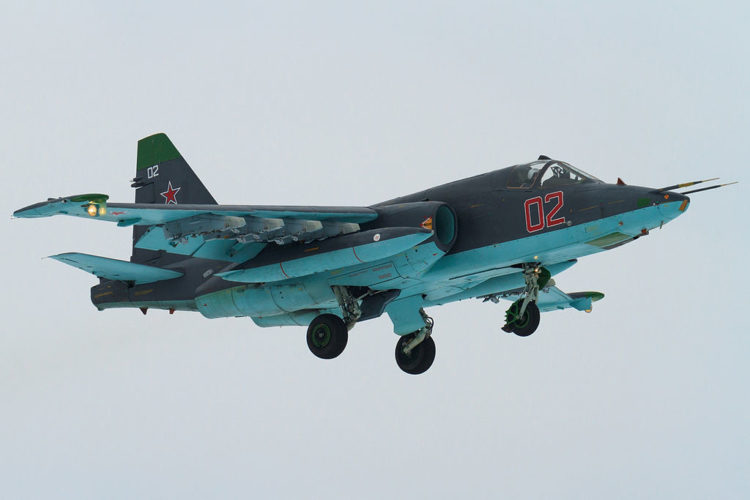
The Russian Sukhoi Su-25, a single-seat attack aircraft, is an integral component of Russia’s air force and has been used in numerous missions since entering service in 1981. Nicknamed the “Frogfoot” by NATO due to its short and broad wings, the Su-25 has been used by Russia to combat insurgencies in several wars. It is one of the most solid attack aircraft in the Russian arsenal and has become synonymous with Russia’s combat operations.
Its design emphasizes low-altitude ground attacks, making it one of the most successful combat aircraft for close air support missions and battlefield interdiction. Low-speed capability and high maneuverability are some core features of this attack jet that give it an edge over other aircraft during air combats or attacking targets from below 4,000 meters. The Su-25 can even perform strictly at low altitudes while carrying a heavy payload, making it highly valuable for anti-armor operations.
Furthermore, this combat jet requires minimal resources to maintain and operate. As a result, many countries have adopted this model as their mainstay fighter plane.
Due to its impressive performance record, the Su-25 found much success on many fronts during conflict resolution efforts in Afghanistan and Chechnya. Its world fame also extended to Iraq, where its precision strikes were invaluable during the 2003 invasion. During these conflicts, the Su-25 was known for being quite accurate when striking targets from very low altitudes, which gave it an advantage over other aircraft specifically designed for such tactics, such as A-10 Warthogs from US Air Force (USAF).
The lasting legacy of the Su-25 led to further development of improved versions such as the Su-25T and modernized versions like the Su-25SM3, which have pushed back every performance limitation that existed before – making it one of Russia’s most reliable attack jets today.
Given this track record, it is clear why Russians rely so heavily upon their iconic Frogfoot, which remains a symbol of their prowess even today despite emerging threats from newer models such as F35 Joint Strike Fighters or F22 Raptors from the USA (Heathcote 2018). This reliance upon existing technology reflects just how well-designed this aircraft is and how vital its role remains in modern conflicts regardless of developments in aeros








COMMENTS