

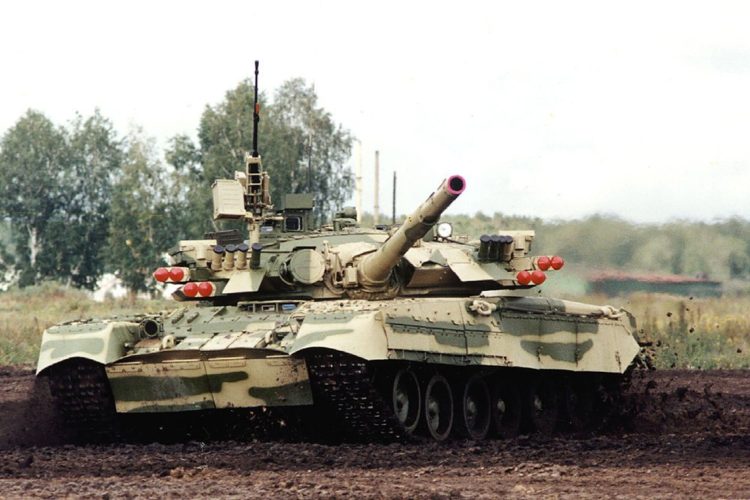
The T-80UM2 MBT was originally part of the Black Eagle (Chiorny Oriol) tank program begun in the 1980s with the first appearance of the tank in 1997, allegedly appearing briefly during a demonstration held in Omsk in 1997. However, it was soon revealed that the turret installed during the demonstration was just a mock-up. A few years after the demonstration, Russia released details about a new tank being developed from its T-80 MBT, which was now the T-80UM2. Military observers determined that the Black Eagle tank and the T-80UM2 were exactly the same tanks due to them looking exactly identical. However, this could not be verified.
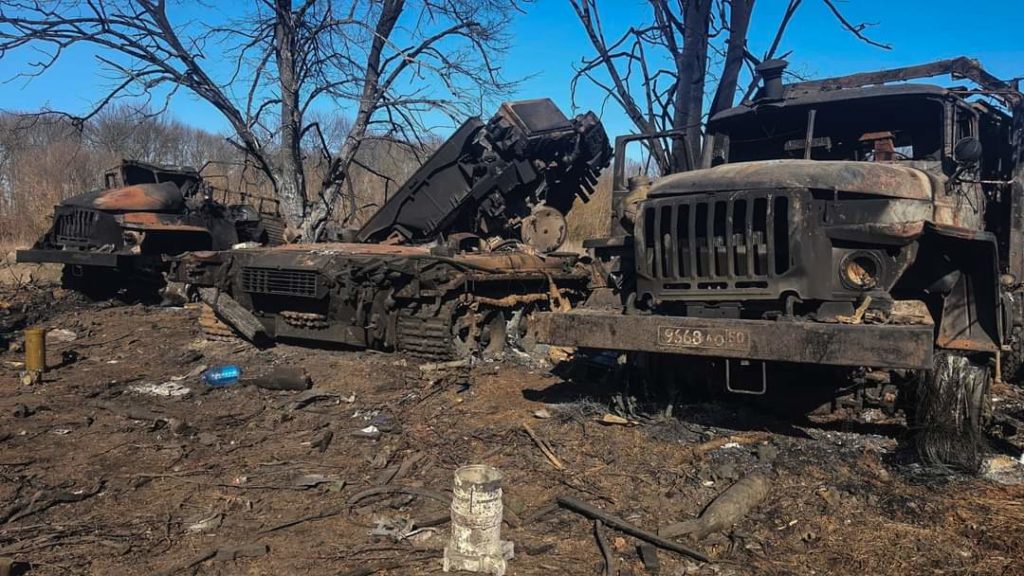
The T-80UM2 MBT, according to some sources, was a tank using a lengthened T-80U main battle tank chassis that was designed with a new welded steel turret and upgraded armor for the hull and the turret itself (which did not seem to help as the turret had been blown off). This advanced armor is known as the Kaktus explosive reactive armor (ERA), which provides extra protection against high explosive anti-tank attacks and kinetic energy attacks. Anti-fragmentation screens were also seen with the tank’s track skirts. It was also said to be powered by a GTD-1250G turbine, which a diesel engine could replace.
However, something peculiar about this tank was that the gunner’s seat was found on the right, and the commander was situated to the left. This makes the turret crew positions reversed compared to the typical Russian T-80U. However, it still uses the 125mm 2A45M smoothbore gun but with a bustle-mounted automatic loader. The ammunition storage is also improved as it was placed at the turret bustle compared to the other Russian tank types. This was probably done to avoid the turret being blown off completely as the ammunition would explode when pierced through by anti-tank weapons, notably during the fighting in the Middle East and Chechnya. The photos of the T-80UM2 shows its turret blown off which is common to Russian tanks with ammunition stored in the turret, so the armored box system said to be a part of the this new tank may not have been operational. In the M1A Abrams model, the main gun ammunition is stored in an armored box isolated from thr crew compartment to prevent a “cook off” of the rounds that would kill the crew.
Online photos from btvt.info suggest that the tank had been using Drozd (or Drozd 2) active protection system, an active protection system (APS) designed to detect anti-tank missiles before being potentially hit. A 107mm High Explosive Fragmentation (HE-FRAG) munitions are fired from the tank to destroy said missile or rocket, helping it survive. Furthermore, the Russians said that the prototype was allegedly 58% more effective than its T-80 main battle tanks. However, btvt.info later corrected their assessment and found out that the official designation of the tank was T-80 with Drozd APS (ADS) and not the T-80UM2.
Some corrections – the official designation of the tank is “T-80 with Drozd APS (ADS)”
Not T-80UM2 and not Drozd-2. Drozd-2 (ТКБ-0252, completely different APS) tests on T-72BK tank were conducted only in 2020 and it is unknown whether it was fielded. pic.twitter.com/x8AZEmSTQy— Andrei_bt (@AndreiBtvt) March 20, 2022
This would lead to the question of why Russia had been sending prototype and experimental weapons to Ukraine. Military observers have said that this is a sign that Russia was running low on military vehicles and munitions as they were seen to be deploying various experimental weapons, including the very recent Kinhzal missiles used to destroy an underground warehouse of missiles and aviation ammunition in Delyatyn, Ukraine.
The Russian forces were also seen to be deploying some rather unorthodox vehicles to fight in Ukraine, as seen by online videos where a number of UAZ-variant cabs over off-road vans were being shipped to Ukraine. Another theory is that they are really deploying these experimental weapons to test them out on the real battlefield and assess what improvements need to be taken into account before massively producing them. In this case, the experiment would seem to have failed.
Russia may be trying to save on its tank units as Oryx reports that 109 tanks were destroyed, 4 were damaged, 111 were captured, and 39 were abandoned. Russia reportedly has a 12,400 tank armada, so it’s not likely to run out of tanks very soon. Still, it may be the case that they know they have been suffering a huge number of losses, and it is their method of coping with said losses – by emptying their warehouses of prototype and experimental models to replace their losses.
However, Uralvagonzavod, Russia’s tank manufacturer, has reportedly stopped production because of a lack of component parts, according to NEXTA, which would indicate that they do not have the resources to maintain its huge armada of tanks, more so to build more units. With the Ruble in the toilet, this tank maker would find itself paying as much as one-third more for parts.
#Russia's only tank manufacturer, Uralvagonzavod, has stopped its production. The main reason for this is a lack of component parts. pic.twitter.com/hss7YrQaSU
— NEXTA (@nexta_tv) March 22, 2022








COMMENTS